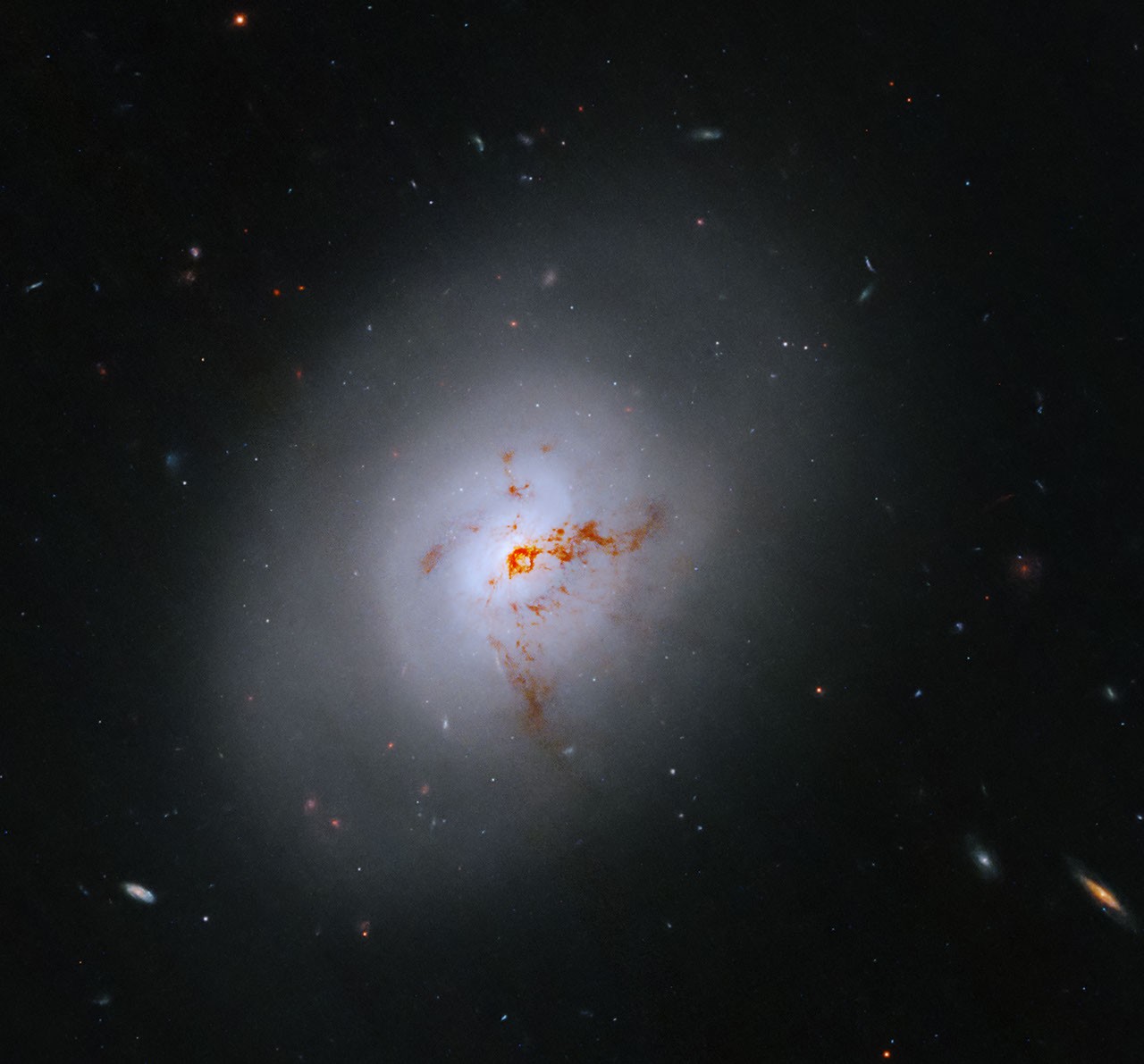
In a stunning new image, NASA's Hubble Space Telescope has captured NGC 1266, a rare lenticular galaxy undergoing a dramatic transition from starburst to quiescence. Located 100 million light-years away in the constellation Eridanus, this galaxy offers astronomers a unique glimpse into the final stages of a galaxy's life cycle.
The image reveals a bright, bulging center with hints of spiral structure but no distinct arms, obscured by reddish-brown dust filaments. Distant galaxies shine through its diffuse outskirts, providing a rich backdrop.
"NGC 1266 is one of only about one percent of local galaxies in this post-starburst phase," explained Dr. K. Alatalo of the Space Telescope Science Institute. "It's like catching a galaxy right after a major party, when the fireworks have stopped but the embers are still glowing."
Astronomers classify NGC 1266 as a lenticular galaxy, a transitional type between spirals and ellipticals. It possesses a central bulge and flattened disk like a spiral, but lacks spiral arms and has minimal star formation—traits of an elliptical.
However, the galaxy's most intriguing feature is its post-starburst status. Roughly 500 million years ago, a minor merger with another galaxy triggered a burst of star formation and funneled gas into its supermassive black hole, creating an active galactic nucleus. Now, star formation has ceased, leaving a young stellar population but no star-forming regions.
Background
Lenticular galaxies are often called "lens-shaped" and serve as an evolutionary bridge. NGC 1266's classification as a post-starburst galaxy makes it exceptionally rare—only 1% of local galaxies share this stage.
The merger that drove this transformation also increased the mass of the galaxy's central bulge and fed the central black hole, making it more active. Such events are key to understanding how galaxies evolve from active, star-forming systems to quiet ellipticals.
What This Means
This observation provides a direct snapshot of a galaxy in a critical evolutionary phase. By studying NGC 1266, astronomers can test models of galaxy evolution, particularly how mergers trigger starbursts and then shut down star formation.
"Understanding post-starburst galaxies helps us piece together the sequence of events that lead to the death of star formation in galaxies," noted Alatalo. "NGC 1266 is a perfect laboratory for this."
The findings also have implications for black hole growth and feedback mechanisms. The active galactic nucleus may be heating or expelling gas, preventing new stars from forming, a process that remains poorly understood.
Hubble's high-resolution imaging allows astronomers to study the intricate dust lanes and structure, offering clues to the merger history and current state of this enigmatic galaxy.
For more on galaxy evolution, see our Background section and explore how lenticulars fit into the picture.